Inside a Stellar Corpse: JWST Reveals the Exposed Core of a Dying Star in Unprecedented Detail
·5 min read
Star formation processes are fundamentally dictated by the mass of the resulting celestial bodies.
The contemporary Morgan-Keenan spectral classification system categorizes stars based on surface temperature ranges, with each class denoted by specific characteristics. The majority of current stars are M-type, while O and B-class stars are rare within 25 parsecs. Our Sun belongs to the G-class, comprising approximately 5-10% of stellar populations. In the early universe, however, O and B-class stars were predominant, with masses roughly 25 times greater than today's average stars. High-mass stars have shorter lifespans and end in more energetic events.
Credit: LucasVB/Wikimedia Commons; Annotations: E. Siegel
Stars similar to our Sun progress through evolutionary stages, expanding into red giants before shedding their outer layers and collapsing into white dwarfs.
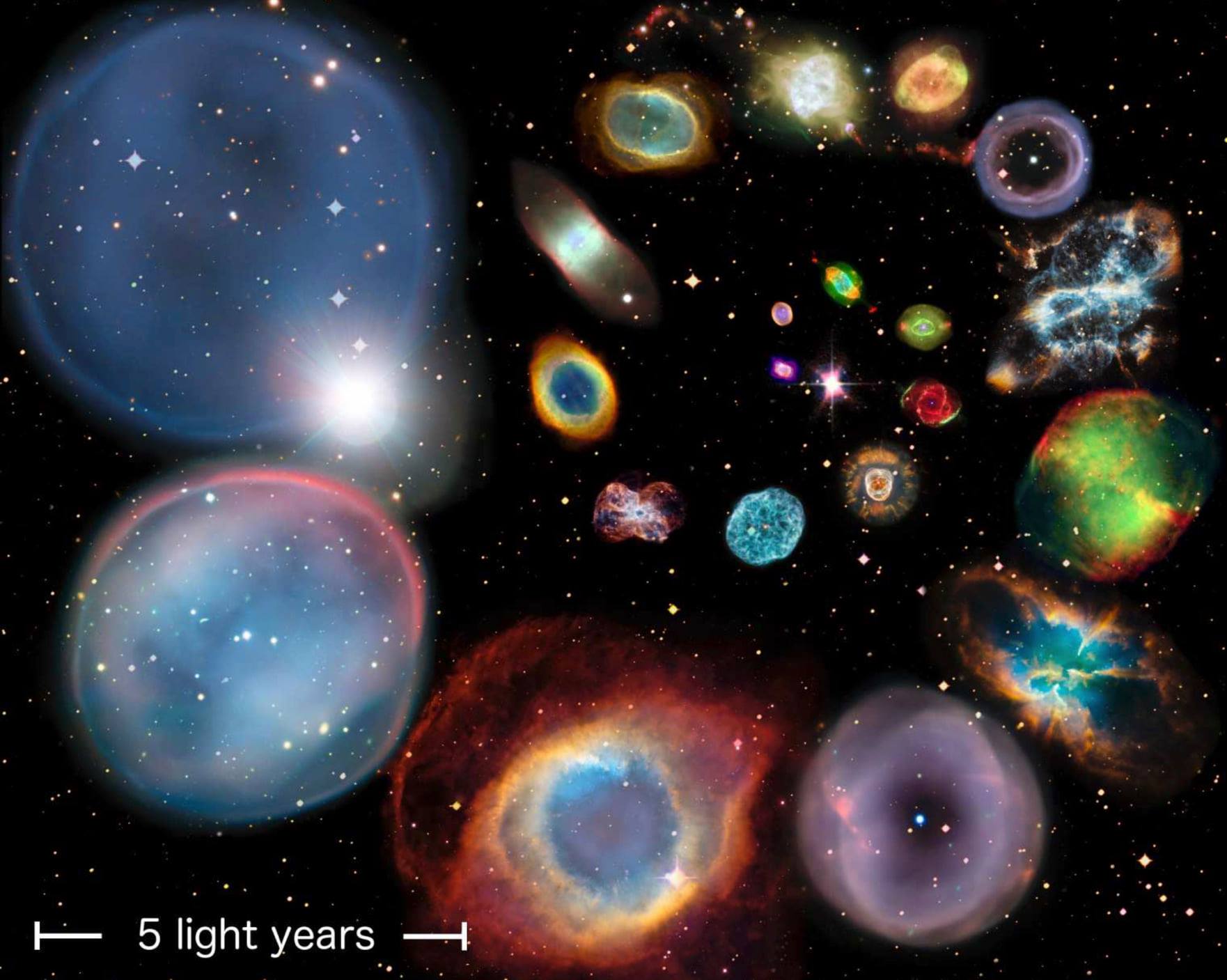
Sun-like stars can expand to sizes comparable to Earth's orbit during their red giant phase, reaching up to five light-years in diameter. Some planetary nebulae extend to ten light-years across. Stars with masses below eight solar masses typically follow this evolutionary path. However, determining the exact fate of a sun-like star remains complex due to observational limitations.
Credit: Ivan Bojičić, Quentin Parker, and David Frew, Laboratory for Space Research, HKU
More massive stars evolve into supergiants, ultimately culminating in supernova explosions.
When hydrogen fuel depletes in a star’s core, it transitions off the main sequence, evolving into subgiants, then red giants, followed by helium ignition. High-mass stars proceed toward supergiants, whereas lower-mass stars enter the asymptotic giant branch. The ultimate destiny of a star is primarily determined by its mass, although internal dynamics also play a role in fusion rates.
The boundary between these two evolutionary paths is not always clear-cut, as both types experience mass loss and ejecta prior to their final stages.
This infographic presents nine historical supernovae identified over the past 2000 years in the Milky Way. Not included is G1.9+0.3, which occurred near the galactic center about 155 years ago but was discovered in 1985. Observations of supernova remnants largely rely on NASA's Chandra X-ray Observatory.
Approximately 5000 light-years away lies the faint nebula PMR 1, whose future remains uncertain.
This Digitized Sky Survey image highlights the region where PMR 1, known as the Exposed Cranium Nebula, resides. No visible signature of the nebula is apparent in optical wavelengths.
Credit: Digitized Sky Survey/Association for Universities for Research in Astronomy; Animation: E. Siegel
NASA's Spitzer mission revealed its structure in 2013, leading to its nickname: the Exposed Cranium Nebula.
The first high-resolution image of the nebula surrounding the central star of PMR 1 was captured by Spitzer in 2013. Scientists named it "Exposed Cranium Nebula" due to its shape. The ionized gas at the center is encircled by a reservoir of hydrogen, reflecting the maximum scientific value extractable from Spitzer data.
Credit: NASA/JPL-Caltech/J. Hora (Harvard-Smithsonian CfA)
Despite its capabilities, Gaia data showed no visually striking features in the region of PMR 1.
This view of a specific area of space includes many objects highlighted in blue circles. The red circle marks the location of PMR 1 and the Exposed Cranium Nebula, which lacks a visually compelling signature in Gaia data.
Credit: ESA/Gaia, Legacy Surveys/D. Lang (Perimeter Institute); Animation: E. Siegel
It only revealed a reddened core, indicating a dust-laden environment.
Using Gaia data, the cores of many nebulae were cataloged, including the Exposed Cranium Nebula, marked as PMR 1 here. It stands out as one of the most heavily reddened objects, appearing far to the right on the graph among other nebulae cores.
Credit: N. Chornay and N.A. Walton, Astronomy & Astrophysics, 2020
JWST recently captured images of PMR 1 using both NIRCam and MIRI instruments.
JWST imaged the Exposed Cranium Nebula across eight different filters, covering near-infrared and mid-infrared wavelengths. While the nebula measures about two light-years in diameter, the NIRCam and MIRI views reveal vastly different details, highlighting both the nebula and its surroundings.
Credit: NASA, ESA, CSA, STScI; Image Processing: Joseph DePasquale (STScI)
Near-infrared observations reveal early hydrogen ejections and intricate, dusty internal structures.
At the heart of the Exposed Cranium Nebula lies a star several times more massive than the Sun, approaching the threshold between those that form planetary nebulae and white dwarfs versus those that explode as supernovae and leave behind neutron stars. The layered ejecta surrounding the central star create ambiguity regarding its ultimate fate despite the clarity of JWST imagery.
Credit: NASA, ESA, CSA, STScI; Image Processing: Joseph DePasquale (STScI)
Mid-infrared views emphasize heated dust components, including along the dust lanes.
The MIRI instrument on JWST provides insights into two distinct phases of the nebula's formation: an initial stage dominated by hydrogen expulsion, followed by a more complex material mixture closer to the center. More ejected material is visible in MIRI's views compared to NIRCam's, illustrating the asymmetry of the nebula.
Credit: NASA, ESA, CSA, STScI; Image Processing: Joseph DePasquale (STScI)
While NIRCam data divides the exposed cranium’s “hemispheres,” MIRI data unifies them.
The central dust lane dividing the Exposed Cranium Nebula appears differently in mid-infrared (left) and near-infrared (right) views from JWST. MIRI emphasizes heated material within or behind the dust, revealing an extended structure, while NIRCam’s views are obscured by the dust, creating a hemispherical appearance.
Credit: NASA, ESA, CSA, STScI; Image Processing: Joseph DePasquale (STScI)
The central star’s ultimate fate remains undetermined.
This view of the central core of the Exposed Cranium Nebula shows the brightest star near the center, possibly a red giant or supergiant located behind the central dust lane. Its mass, nature, and future remain unclear at this time.
Credit: NASA, ESA, CSA, STScI; Image Processing: Joseph DePasquale (STScI)
It may be a Wolf-Rayet star destined for a supernova.
The luminous, hot star Wolf-Rayet 124 (WR 124), prominent in this James Webb Space Telescope composite image, radiates at about 120,000 K and has a mass of approximately 30 solar masses, with 10 solar masses already expelled. Its future is expected to be a supernova, and the Exposed Cranium Nebula might follow a similar trajectory.
Credit: NASA, ESA, CSA, STScI, Webb ERO Production Team
Alternatively, it could evolve into a preplanetary nebula before becoming a white dwarf.
This Hubble image of the Egg Nebula showcases freshly ejected stardust from a post-AGB star illuminated by a contracting central star. While the Exposed Cranium Nebula is in an earlier evolutionary stage, it may yet develop into a preplanetary nebula before eventually becoming a white dwarf.
Regardless of its fate, JWST's capabilities have unveiled unprecedented cosmic details.
This alternating view of the Exposed Cranium Nebula showcases the alignment of NIRCam and MIRI data. Near-infrared views highlight the central dust lane and numerous stars, while mid-infrared views emphasize heated internal materials. By observing the Universe across multiple wavelengths, a diverse array of details becomes evident.
Credit: NASA, ESA, CSA, STScI; Image Processing: Joseph DePasquale (STScI); Animation: E. Siegel
Mostly Mute Monday tells an astronomical story in images, visuals, and no more than 200 words.