Editor’s Note: The following story contains mentions of self-harm and sexual assault. If you or someone you know is struggling, call or text 988 or visit 988lifeline.org to reach the Suicide & Crisis Lifeline. To reach the National Sexual Assault Hotline, call 1-800-656-HOPE (4673) or visit online.rainn.org.
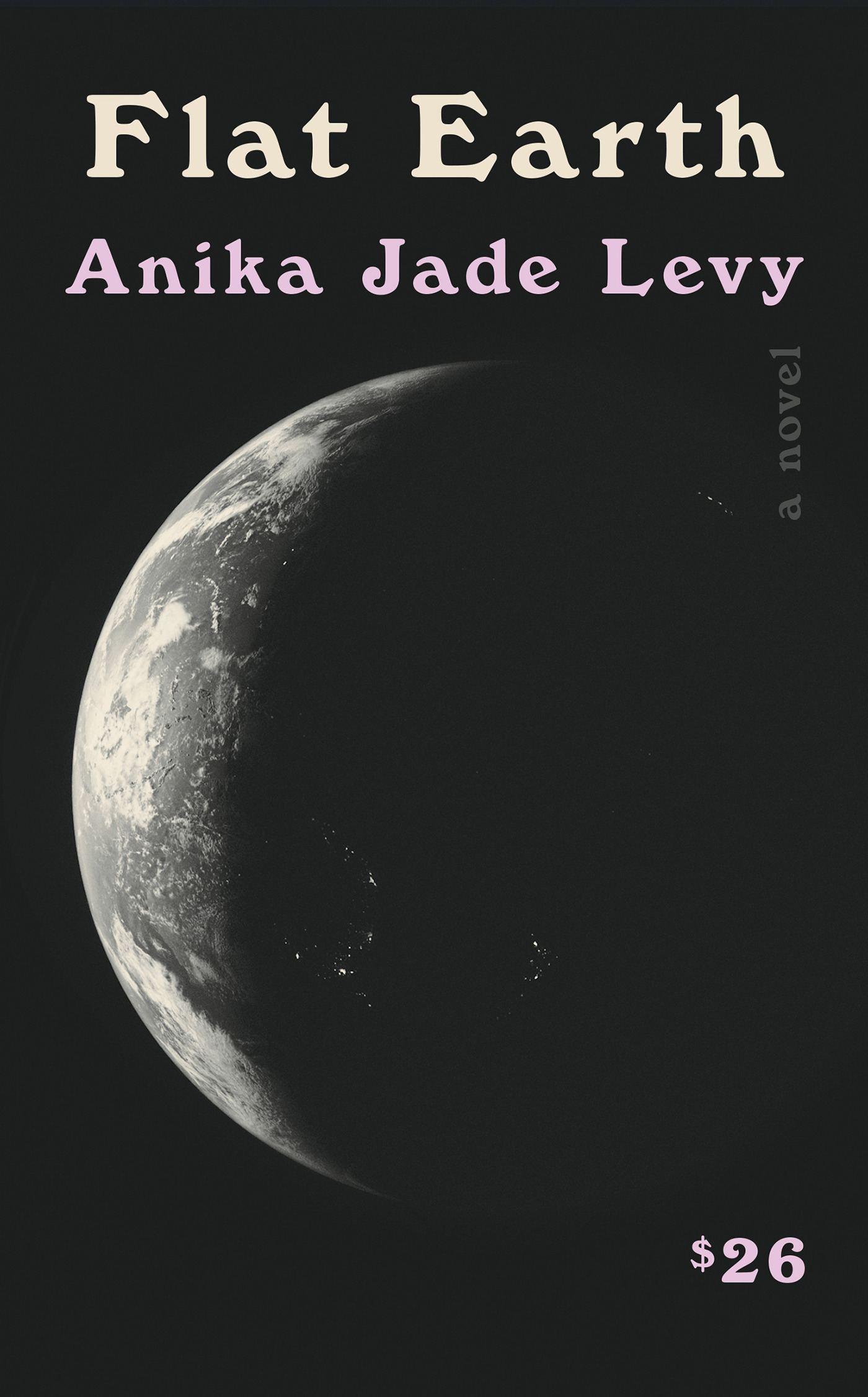
Summarizing the narrative of Anika Jade Levy’s Flat Earth (2025) is itself a somewhat futile exercise. At its structural core, the novel centers on Avery, a protagonist loosely enrolled in a graduate media studies program, consumed by envy toward her closest companion, Frances — an effortlessly magnetic heir to a shipping fortune whose documentary on flat-earth conspiracy theorists in America’s overlooked interior catapults her into sudden art-world celebrity.
Levy populates Avery’s characterization with a constellation of obliquely unsettling details: she stores Frances’s severed fishtail braid in a Tupperware container beneath her mattress; she pursues a law professor specifically because his behavior toward her is “sufficiently violent”; she dismisses a well-bred obituarist as a potential lover for being too considerate. These details gesture toward psychological complexity without ever committing to it. They register as affectations rather than revelations — surface textures masquerading as depth. Avery demonstrates virtually no impulse toward self-examination, as though she has already concluded that the interior landscape isn’t worth mapping. The reader is left with a protagonist whose vacancy feels less like a deliberate artistic construction and more like a structural absence the novel never bothers to address.
The obvious counterargument — that the emptiness is precisely the point — has some merit, and it’s the defense the novel seems to be banking on. A uniformly detached register runs through the entire text, not merely as a function of Avery’s narrative voice but as the book’s governing aesthetic philosophy. Levy works in spare, clipped units of prose that pivot on dry, affect-free reversals: “If I had endometriosis, that meant I might never be able to have a baby. On the other hand, maybe I could write about my diagnosis for a feminist magazine.” In this mode — the brief, tonally flat observation that pivots on a hollow irony — Levy genuinely excels. The technique is formally controlled and often startling. But these flashes of precision dissipate almost immediately, like catching a glare off a stranger’s phone screen only to realize it illuminated nothing at all.
Consider another disquieting sentence: “I saw the boy who sexually assaulted me in high school had earned an advanced degree in public policy and city planning.” The line functions as another data point in Levy’s portrait of a woman so thoroughly anesthetized that even the most severe personal trauma fails to produce a measurable emotional response. There is something culturally diagnostic about this — the psychic numbness, the inward collapse under the weight of accumulated overwhelm, is genuinely legible as a defining pathology of the contemporary moment, visible everywhere from doomscrolling behavior to the curatorial sensibility of the Whitney Biennial. The problem is that Levy deploys this gesture repeatedly, with diminishing returns each time. By the time assault becomes a setup rather than a reckoning, the technique has exhausted its own novelty — it feels worn out in both the emotional and literary sense.
Every narrative development operates on the same principle: a knowing cultural reference delivered with studied indifference — Adderall shortages, algorithmic egg-freezing advertisements, QAnon mythology, incel subcultures. The cumulative effect is a world in which nothing — no person, no event, no object — possesses genuine weight or consequence. Everything dissolves into a kind of nihilistic remix, a 21st-century recombination where meaning is perpetually deferred. An Australian life coach who dispenses reliably disastrous counsel to Avery dies by suicide; the attentive obituarist Avery refuses to sleep with writes her death notice. The symmetry is clever in a mechanical way. But Flat Earth is not a novel that accumulates resonance, that lodges in the reader’s consciousness and gradually deepens, casting new light on experience or on its own formal choices the way enduring literary work does. It is, instead, a novel that performs intelligence as a substitute for feeling — one that critiques the condition of being unmoved by reproducing that condition, page after page, until the text becomes as frictionless as the scrolling it invokes.
What compounds the problem is a more fundamental structural contradiction. Flat Earth positions itself as a critique of blasé disaffection while being wholly constituted by it — it wants both the diagnostic authority of the observer and the aesthetic permission of the thing being observed. This is a move endemic to a particular strain of contemporary art-world self-consciousness: the preemptive absorption of criticism through ironic self-awareness, which ultimately functions as a sophisticated form of evasion. It metabolizes its own failures and reframes them as intentions, because genuine artistic risk is harder than recursive self-commentary. The strategy produces moments where writing that borders on Rupi Kaur-adjacent earnestness — “We love you enduring your father”; “where the Sculptor had seen a castle, I had only seen a ruin” — becomes so thoroughly insulated by layers of irony that sincerity and parody become indistinguishable. Whether that ambiguity is a feature or a failure is, characteristically, left unresolved.
None of this is an indictment of the novel’s underlying subject matter. The territory of hyper-contemporary malaise is not inherently exhausted — it remains fertile ground for writers willing to engage it with genuine ethical stakes. Vincenzo Latronico’s Perfection (2022) operates with a comparable formal economy and a similarly withering critique of digital culture’s flattening of experience, but it carries within it a moral orientation — a legible judgment about the position it describes. Thoughtful fiction need not supply answers; it must, however, sustain inquiry. And it is entirely possible to construct a character who appears emotionally evacuated while remaining fully realized as a human subject, as Nella Larsen’s Quicksand (1928) demonstrates — a novel that, as scholars including Sianne Ngai have observed, directs readerly attention toward the structural and social forces that produce such strangely affectless subjects. Avery, by contrast, functions less as a victim of those systems than as their undifferentiated symptom.
There is no shortage of real people who have constructed their identities around the same archetype Avery embodies — that particular variety of studied nullity is well-documented in certain cultural precincts. But the art world, even at its most compromised, encompasses more than the pharmacologically managed ennui of gallery-circuit regulars conducting joyless affairs with ethically dubious professionals. That narrow subgenre feels grotesquely overrepresented in current literary fiction, and Flat Earth is its most recent and most self-satisfied entry. Recursive, solipsistic, and ultimately self-consuming, it is a novel designed for a readership that has confused alienation with sophistication — the art world faithfully rendered for those who have already stopped believing in what art is supposed to do.