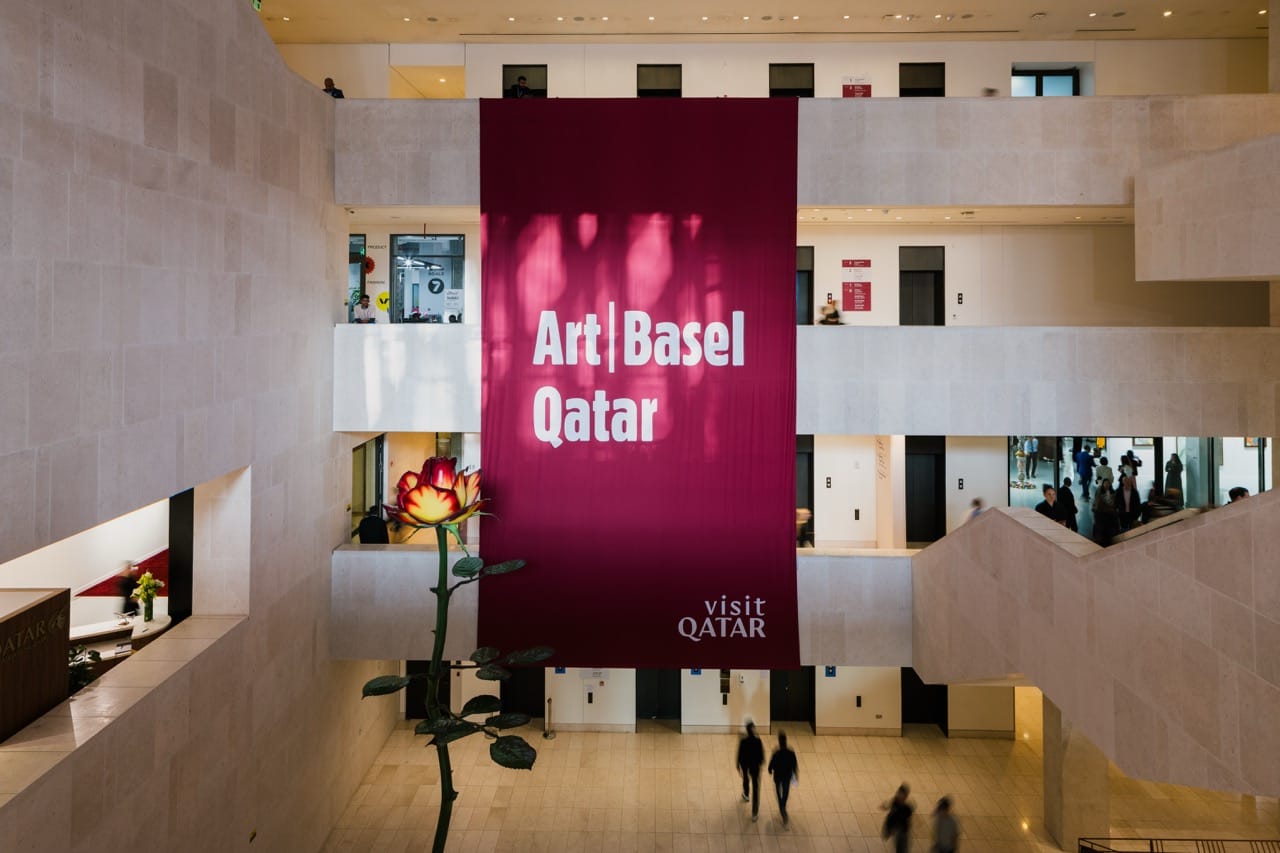
Art Basel Qatar made its formal debut in February under what the organization itself described as a celebration of Qatar's "vibrant cultural landscape" and "dynamic arts ecosystem." That characterization bears little resemblance to the Qatar I lived and endured.
I came of age in Qatar as a queer individual — a fact that placed me in immediate and constant conflict with the society surrounding me. LGBTQ+ people in Qatar are not merely discouraged; they are systematically suppressed. Any deviation from prescribed norms carries serious legal and social consequences. Questioning your family, your government, or religious doctrine is not an act of courage — it is an act of survival risk. Invisibility becomes the only viable strategy for those who differ.
The progressive, culturally flourishing Qatar that Art Basel is actively marketing to the world is a constructed fiction — not a functioning reality.
The political architecture I grew up within was that of a totalitarian, authoritarian state governed by hereditary rule. A single ruling family exercises absolute dominion over the nation and its vast resource wealth, transferring power through dynastic succession rather than democratic mandate. The social hierarchy is deeply entrenched: one's family lineage and proximity to the ruling class determine access, privilege, and protection. Among a population approaching three million, Qatari nationals constitute a demographic minority — and within that already-marginalized group, I was marginalized further still.
My formative years unfolded inside what I can only describe in retrospect as a state-engineered propaganda apparatus. Nationalist sentiment and rigid Islamist doctrine were not merely cultural influences — they were institutional mandates. We were conditioned to place God and nation above individual identity or personal autonomy. Civic duty, including the expectation of forming a heterosexual family unit, was presented not as a social norm but as an inviolable obligation. The concept of self-determination — over one's beliefs, one's body, one's capacity to love — was not a right we were permitted to contemplate. Even my heterosexual peers operated within tightly constrained personal freedoms.
Much of what the international community now associates with Qatar — its gleaming skyline, its global ambitions, its cultural infrastructure — did not exist during my childhood. The country was, in the most literal sense, a desert landscape with limited connectivity to the outside world. I had no access to the internet. Arabic was my only language, and within that linguistic world, there was not even a word that captured what it meant to be gay. Transgression carried punishment; resistance carried danger. Challenging family authority, state power, or Islamic doctrine was simply not survivable. My path toward self-understanding only began when I enrolled at Cornell University's Qatar campus medical program and began making trips to New York — a city where I could finally inhabit my own identity without concealment. By the time my medical training concluded in 2015, I understood with complete clarity that returning was not an option. I sought asylum in California, leaving behind everything familiar to preserve everything essential.
Qatar's geopolitical leverage is substantial. Its hydrocarbon reserves — among the most significant in the world — and its role as host to the largest American military installation in the Middle East give it extraordinary strategic value. Maintaining access to that leverage requires Qatar to project an image of modernity, openness, and diplomatic sophistication to its international partners and observers.
Qatar's approach to soft power is methodical and deliberate. It draws global leaders, institutions, and audiences onto its territory through landmark events — the FIFA World Cup, and now Art Basel — and in doing so, absorbs the reputational credibility those platforms carry. It positions itself in alignment with the values those platforms claim to represent, so that the world encounters Qatar through the lens of culture and sport rather than through the lens of its governance. As these platforms expand in reach and prestige, they become instruments that authoritarian regimes can leverage to manage both populations and perceptions. This is artwashing in its most sophisticated and operationally effective form.
International visitors experience Qatar under a different set of rules. They may exercise personal agency. They may hold and express unconventional beliefs. They may, in practice, be openly gay. In exchange, they deliver economic investment, institutional relationships, and — most critically — global legitimacy. Many visitors register the gap between their own freedoms and those of the people who permanently inhabit the country, but the personal and diplomatic costs of speaking publicly about that gap are high. And so the global art and sports establishments continue to lend their prestige to these events while systematically avoiding the question of who is left behind.
When I learned that Art Basel was inaugurating a fair in Qatar, remaining silent felt like a form of complicity. The foundational premise of art is freedom of expression — the unobstructed capacity to create, to dissent, to reveal. By anchoring a flagship international art event in Qatar, the institution implicitly endorses the narrative that this is a space where creative and personal freedom flourish. That narrative is not merely incomplete — it is a deliberate inversion of the lived reality. A nation-state that criminalizes LGBTQ+ existence at the level of law and culture has no legitimate claim to the title of global creative sanctuary.
My account is the testimony of one queer person — but it points toward something far larger than individual experience. It exposes a system of concentrated power that was structurally designed to deny full humanity to people like me. And yet the international community continues to applaud Qatar's cultural ascendancy as though the human cost of that ascendancy is simply not part of the conversation.
Art, at its core, is about transgression without retribution — the freedom to test boundaries and challenge assumptions without fear of punishment. International sport, at its best, is about collective belonging and the radical equality of participation. These are platforms through which human commonality is supposed to be affirmed and celebrated.
But authoritarian states are sophisticated consumers of cultural capital. They understand that perception, once shaped, is remarkably durable — even when audiences are partially aware of the manipulation at work. The World Cup demonstrated this with uncomfortable clarity: despite extensively documented evidence of systematic abuse inflicted on migrant workers who built the tournament's infrastructure, the event proceeded and the global audience largely engaged with it on its own terms. This is precisely why critical scrutiny must encompass the full picture — not merely the curated surfaces that state actors wish to present. The art world cannot credibly position itself as a champion of human expression while simultaneously averting its gaze from those whose expression is criminalized.
Artists and cultural institutions carry the same ethical obligation that I carry as a witness and survivor: to bring unfiltered truth into every space they occupy. Not to calibrate their values to the political sensitivities of their hosts. Not to mute the dimensions of their identity that might cause discomfort. There is no justification for a human being to perform a diminished version of their humanity — and there is no justification for art to be anything less than fully, unflinchingly expressive of the world as it actually exists.