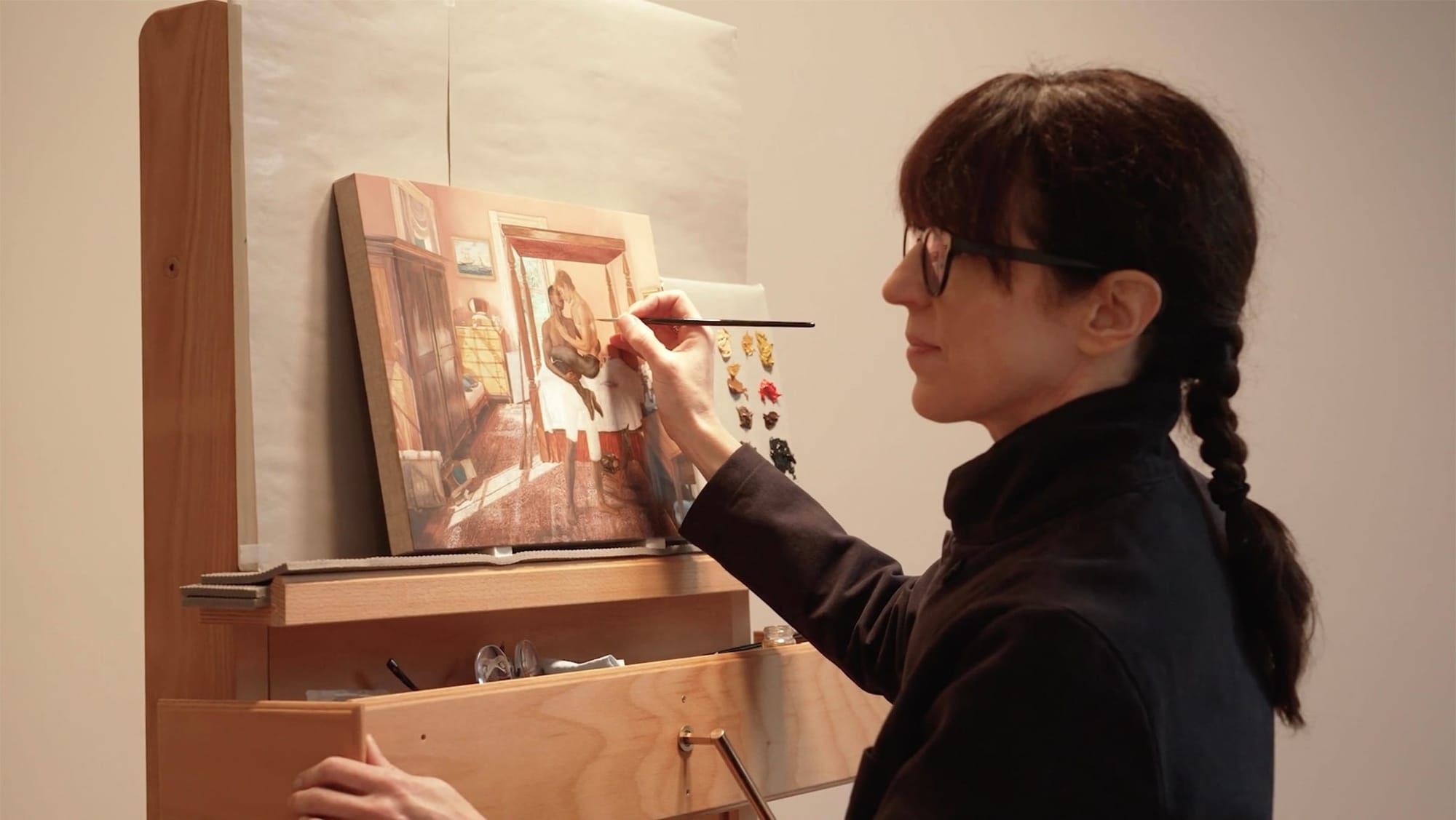
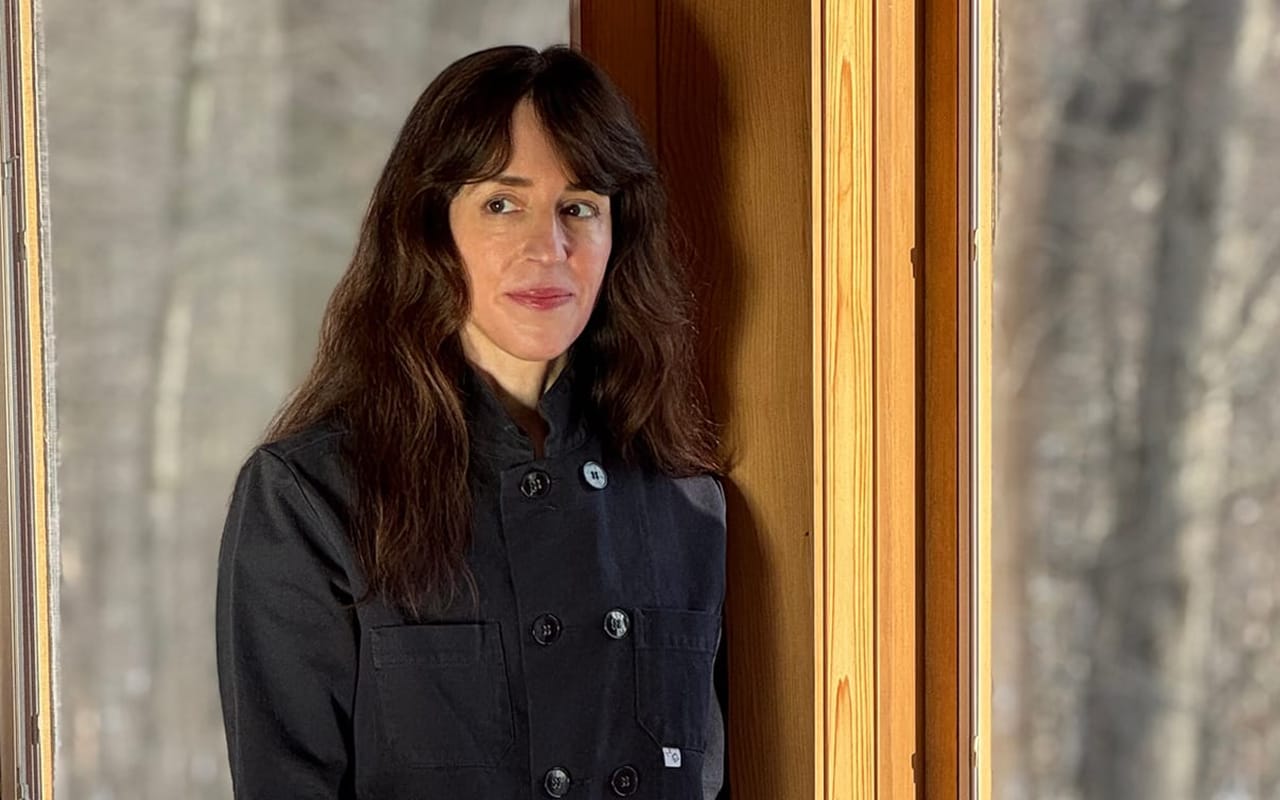
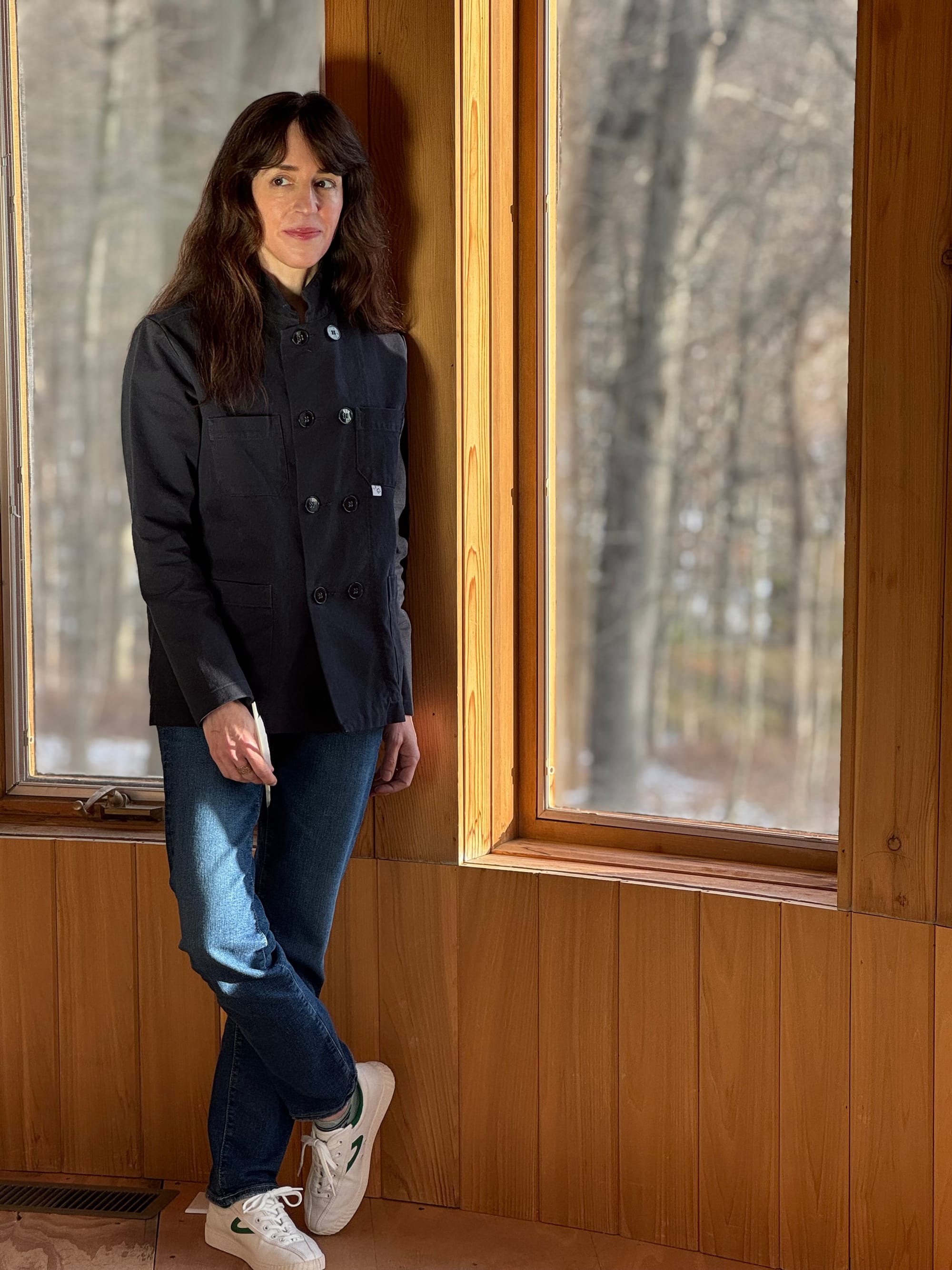
Hilary Harkness is known for her intricate, hyperrealist compositions that densely pack information onto small canvases, often exploring alternate histories through imaginative scenarios. I had the opportunity to engage with her work during her 2023 solo exhibition at PPOW Gallery in New York City, where her latest series was presented in full. Given her location in New Jersey and tight deadlines, we arranged a Zoom meeting to discuss her creative process. Despite the distance, she emphasized that I would experience every aspect of her practice without missing any detail. Even as she revealed layers of her artistic vision, a sense of enigma remained. She has never painted a self-portrait, avoids being photographed, and often centers others in her public discussions about her work.
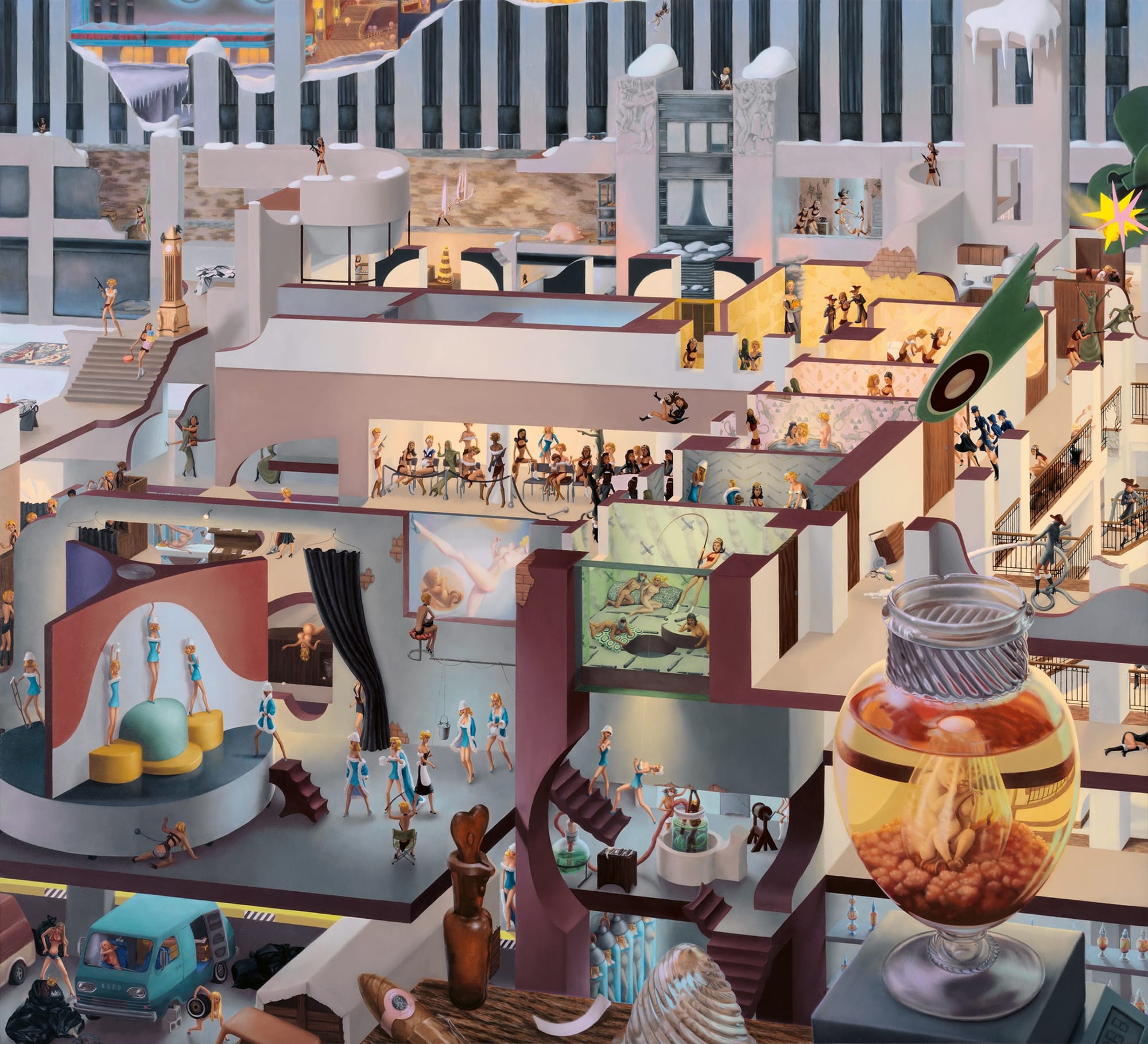
Her paintings are characterized by a maximalist aesthetic, blending preternatural beauty with themes of human frailty such as vengeance, power, hubris, and sensuality. Her cross-sections of World War II-era battleships depict gender-neutral and queer gatherings, while her reimagining of Gertrude Stein and Alice B. Toklas’ relationship exposes psychological nuances. Additionally, she explores the disguises adopted by women who served in the Civil War. These works invite viewers into immersive environments, where familiar elements draw them deeper into complex narratives until they question how they arrived there.
Conversations with Harkness are intellectually stimulating, as she effortlessly references obscure historical facts and cultural touchstones. Our discussion touched on Richard Scarry’s Busytown, hydraulic mining practices, eroticism aboard warships, and the symbolic connections between a violin bow, quill, and paintbrush.
Born in 1971, Harkness earned her BA from the University of California, Berkeley, and an MFA from Yale University. Her work has been showcased at prominent institutions including the FLAG Art Foundation, the Academy of Arts and Letters, the Museo Thyssen-Bornemisza in Madrid, the Portland Institute of Contemporary Art, and the Aldrich Museum of Contemporary Art. She is represented by PPOW Gallery in New York. This interview has been edited for clarity.
Hyperallergic: You grew up in Kalamazoo, Michigan. Did you create art as a child? I'm intrigued by your account of witnessing a tornado tear off the exterior wall of a department store, which may have influenced your cross-sectional paintings.
Hilary Harkness: I had access to quality art supplies and spent time in nature. I was always creating something or engaging in an activity. I read extensively at an early age, with Richard Scarry being one of my favorites. I was fascinated by the level of detail he included in his depictions of Busytown. My education was unconventional, with free-form classroom settings rather than traditional desks.
My mother wasn’t emotionally nurturing, but she demonstrated remarkable courage during a tornado by ensuring the safety of neighbors’ children. I witnessed a five-story building being exposed. It's possible this experience inspired my interest in cross-sectional views.
We lived in a neighborhood with identical tract homes, and my parents prioritized practical needs over aesthetics. The old curtains were never replaced, so everyone could see inside our house. My mother said, “We have nothing to hide.”
H: You initially pursued a pre-med track at UC Berkeley. What led you to shift toward painting?
HH: After completing my pre-med requirements, I decided to take a break. I had the opportunity to study under Mary Lovelace O’Neal and Katherine Sherwood. My time at UC Berkeley was very open-ended, teaching me to approach everything as a work of art—rather than just drawing something on a page, I learned to compose it.
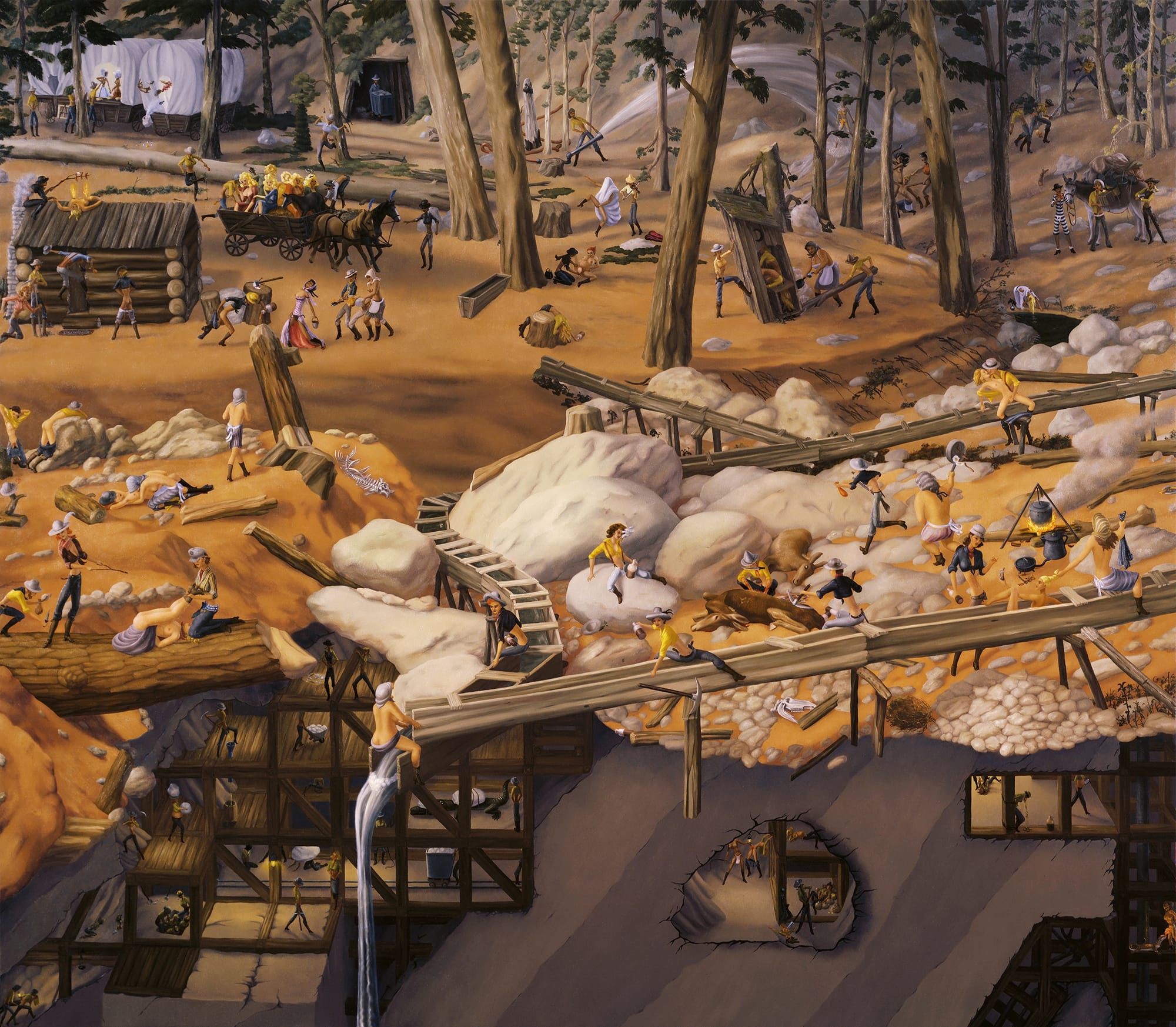
H: Many of your early works depicted labor. Did you feel a connection to Pieter Bruegel? Can you describe the subject of the painting “Golden Gorge” (2007)?
HH: I admire Bruegel’s work. He lived during a time of religious conflict, yet his gaze was gentle. In “Golden Gorge,” I explored the American obsession with quick wealth, particularly during the gold rush era. Hydraulic mining schemes were established by powerful individuals, exploiting those who failed to get rich through prospecting. Women during this period often found opportunities in catering to miners, selling pies or acting as madames. While “Golden Gorge” reflects people who understand how the world works, other paintings like “Motherlode” (2005–6) and “Pearl Trader” (2006) blend commerce with childbirth, presenting intricate scenes of daily life.
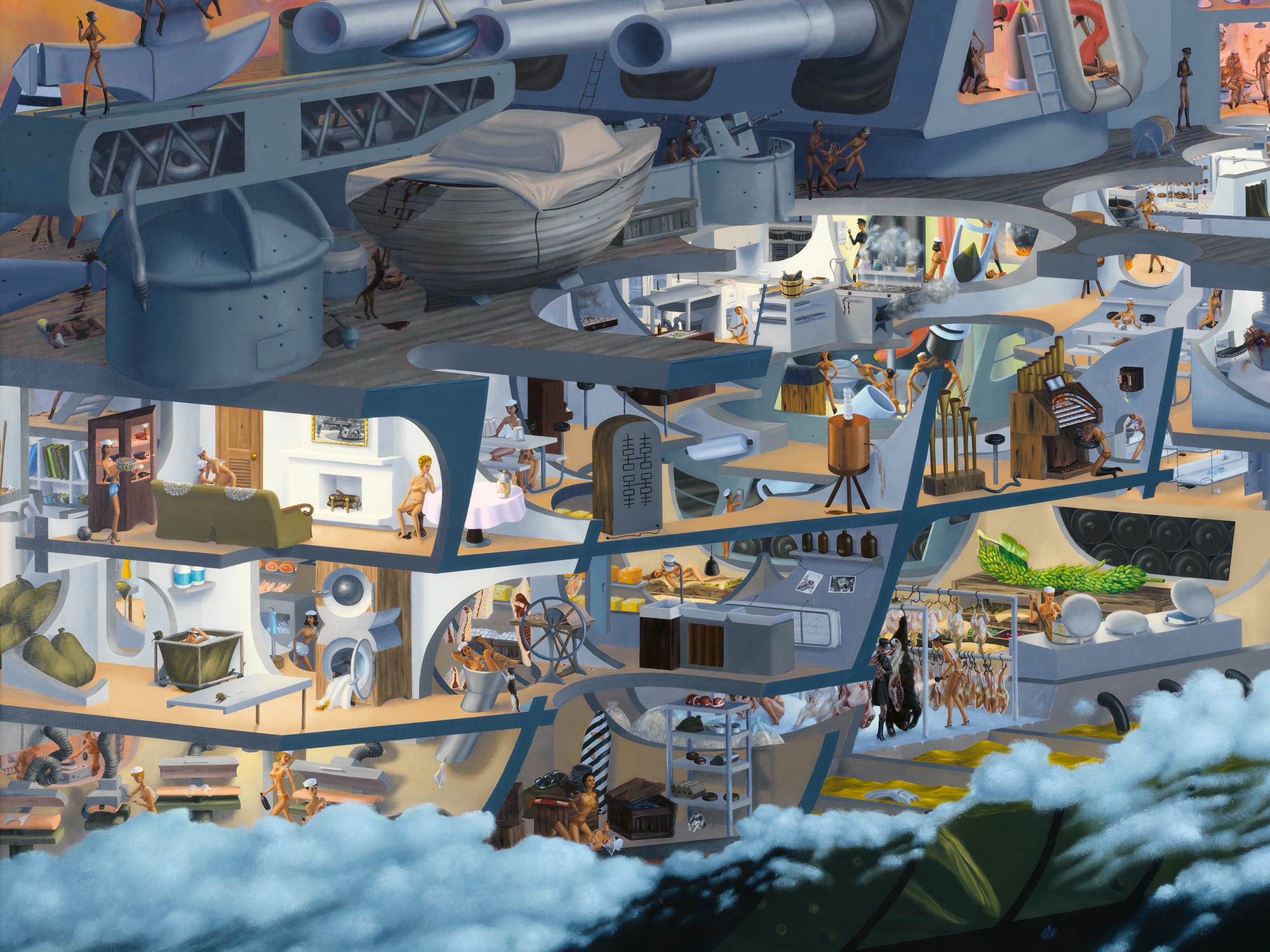
H: Can you explain the figures and themes in your battleship paintings, especially regarding hierarchies, power, gender, and sexuality?
HH: Most people don't know how they'd react in extreme situations. There could be long periods of boredom mixed with intense fear. People turn to anything to distract themselves, including flirting and sexual encounters. I'm also interested in what happens when individuals feel like mere cogs in a system. Researching these battleships revealed numerous accounts of careless mistakes leading to loss of life. I have deep empathy for those sailors.
I’m present in one of the battleship cross-sections—not as a self-portrait, but as part of the crowd. I imagined myself hiding in a laundry bin, reflecting my own fear in such a scenario.
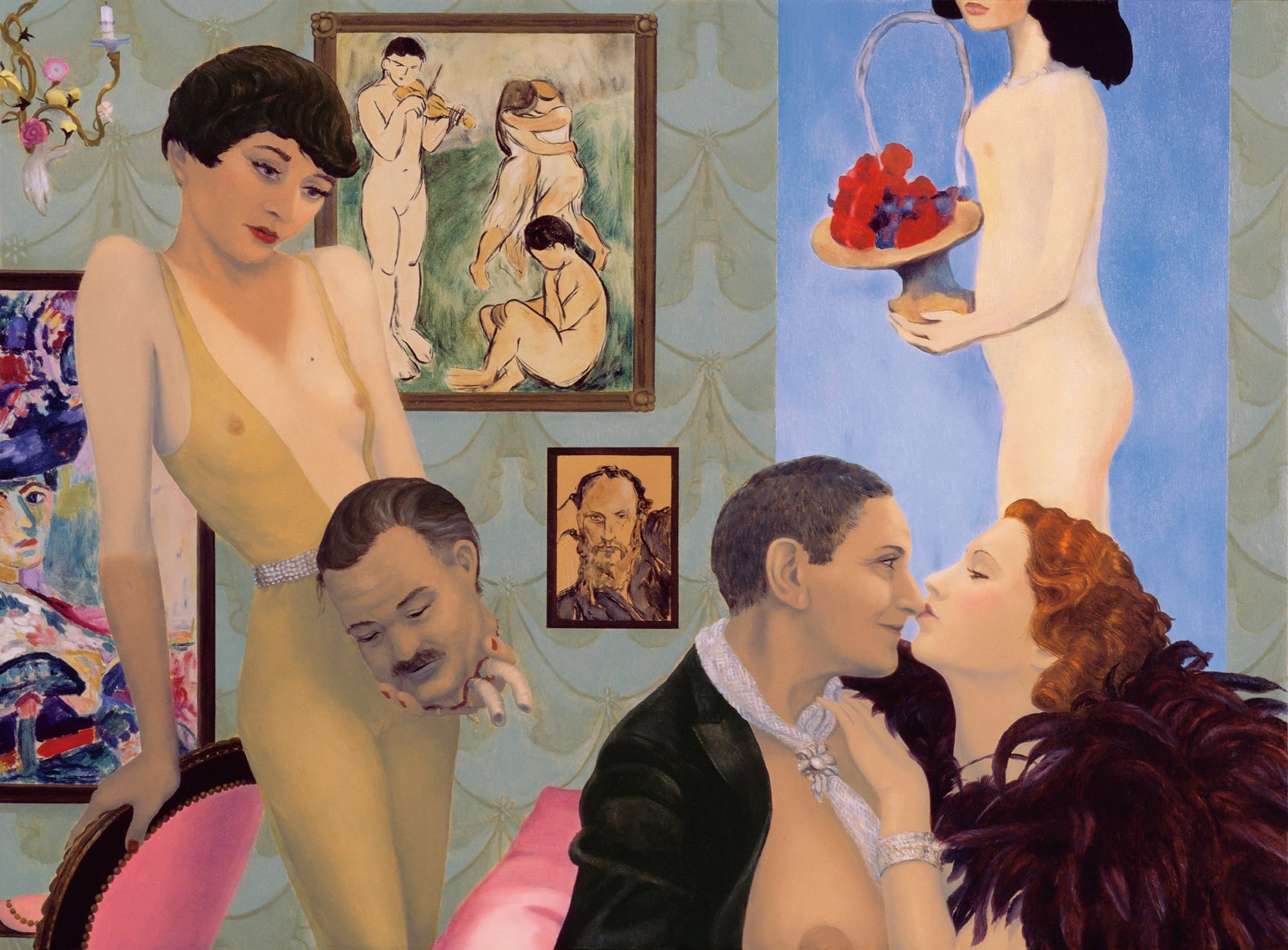
H: I was curious about your ongoing series of paintings featuring Gertrude Stein and Alice B. Toklas. I thought about Picasso’s iconic portrait of Stein and wondered if depicting their likenesses was important to you.
HH: Gertrude Stein is easily recognizable, but Alice is ever-changing. I relate to her elusiveness. Rather than aiming for literal representation, I focus on capturing a mood.
In “Answered Prayers” (2024), Alice waits with Gertrude’s corpse, knowing that once she leaves, the Steins will take everything and leave her penniless. It's true that they left her destitute while she was away seeking an arthritis cure.
H: I hear that you rarely create preliminary sketches or studies for your paintings. Is that accurate?
HH: For some of the early cross-sections, I didn’t even do thumbnails. I used water-soluble colored pencils to make guide marks on the panels and then went straight into painting. Oil paint is forgiving.
“Experienced People Needed” (2018), a painting about Peggy Guggenheim, required careful planning. I had to piece together multiple photographs of installations along a floor plan. It was challenging to integrate all the elements correctly and ensure spatial depth. This method slowed the process but added complexity to the composition.
H: “Nervous in the Service” (2009) depicts a lavish, fantastical cocktail party with dozens of people set across multiple floors of a modernist house filled with art. How did this scene evolve?
HH: I had a collector who experienced significant loss during the AIDS crisis. His impressive art collection inspired the painting. I felt it deserved a celebration through an orgy, which became one of my favorite projects. The props were all in place, and the figures acted as subtle elements within the scene.
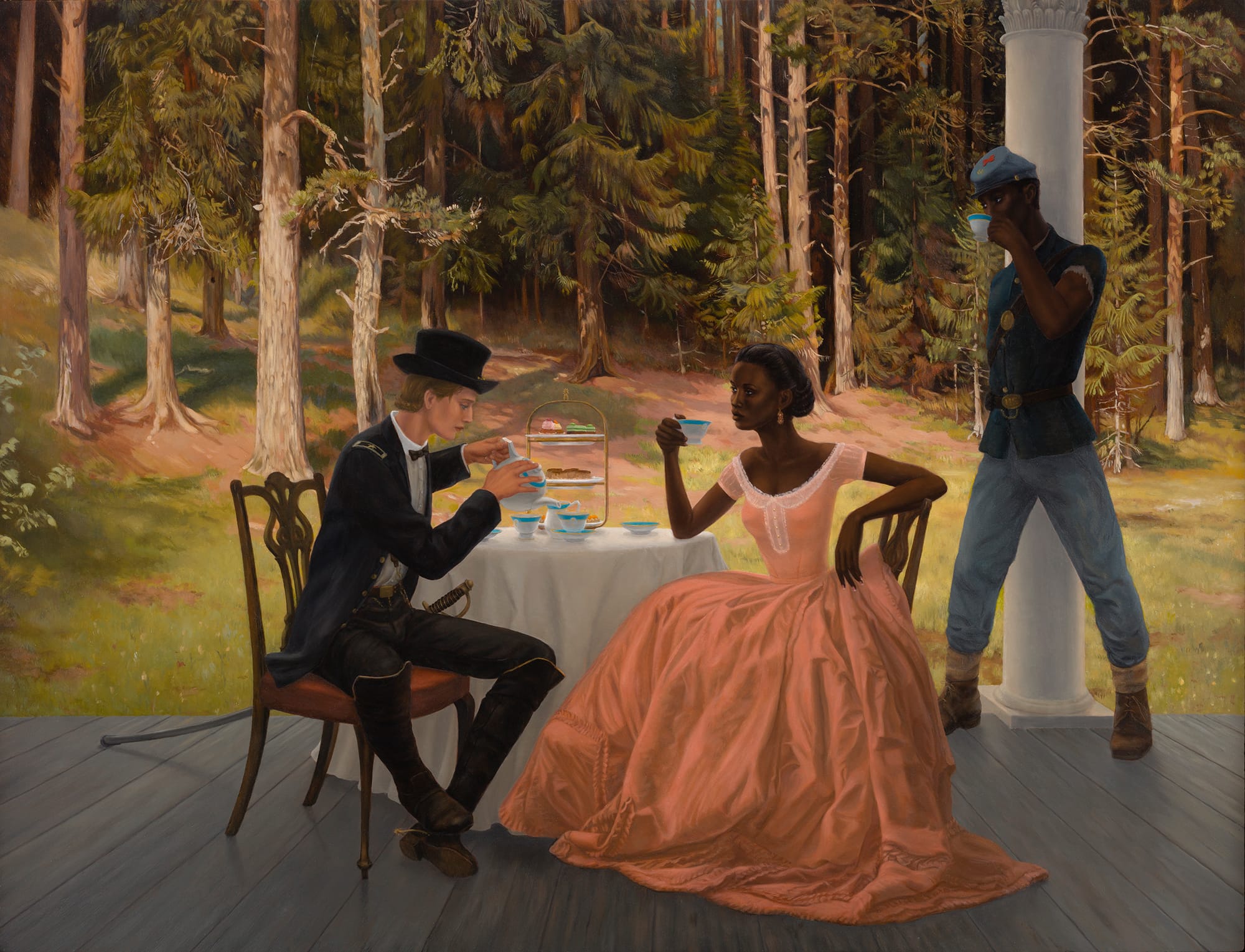
H: Your “Arabella Freeman” series, which presents a narrative about the relationships between a White genderqueer Union soldier and the family of a Black Union soldier, was originally inspired by copying Winslow Homer’s “Prisoners from the Front” (1866) at the Metropolitan Museum of Art, and changing the race of one of the soldiers. You’ve called it a love letter to your wife, Ara. How did this lead you to explore how a free Black family might have lived in Virginia in the 19th century? How do you balance the over-the-top fantastical elements of your painting with an interest in historical truths?
HH: The “Arabella Freeman” series began as an exploration of my wife’s life experiences and how they shaped her identity. It’s a story of Black wealth, art collecting, land ownership, and the ongoing legal challenges faced by Black communities. The series started with a “what if” scenario, which evolved into a broader narrative.
As a white artist portraying Black subjects, I acknowledge my lack of lived experience. My wife is Black, and I walk beside her, observing the microaggressions and systemic challenges she faces. My art is not about certainty but about posing questions, engaging with others, and striving to understand the world more deeply.
I am currently expanding the “Arabella Freeman” series, using friends who are artists as models, including Moses Leonardo and Alannah Farrell. Nonbinary and trans individuals have been instrumental in supporting my work, offering both creativity and generosity. Their presence in the studio has transformed my artistic experience.
H: You've recently been studying calligraphy. How did this come about?
HH: In October 2023, I worked on a project for Headmaster Magazine involving dip pen drawings of Oscar Wilde and his friends in ballet slippers with bows. Although I'm not a dip pen artist, I found the challenge fascinating. It requires precise control and a delicate touch.
Last November, I attended a three-day calligraphy workshop in Brighton, England, led by Ewan Clayton. The experience was transformative. Ewan created a welcoming environment that encouraged curiosity and emotional engagement, making it accessible to all skill levels.
Currently, I'm learning to write with a real quill. The quill vibrates against the paper, feeling alive in the hand. As a former violinist, I find the connection between the violin bow and the paintbrush intriguing. Both require sensitivity and control.
The act of painting is fundamentally about making a single brushstroke that feels good. This moment depends on the interaction between paint, surface, posture, breathing, and grip. If the paint doesn’t feel right, the entire process falters. It’s about that immediate, daily experience, which must be fulfilling and meaningful.
H: You’ve mentioned that the most satisfying outcome would be reaching old age and seeing the variety of things you've done throughout your career. Why is that?
HH: When I was an emerging artist, I looked forward to being a painter in my 50s. Cézanne peaked in his 50s, and the idea of a long-term artistic journey appealed to me. Now that I’m here, painting remains challenging, even with experience and energy. I’m grateful for my health and the ability to continue creating. However, being a “bad beginner” allows for playfulness and curiosity, which are essential for growth.
What occurs in my studio is a marathon, and it can’t be the sole focus of life. It won’t foster the kind of growth I want as an artist. I’m exploring different activities that support a holistic mind-body-spirit connection, keeping the creative process vibrant and dynamic.