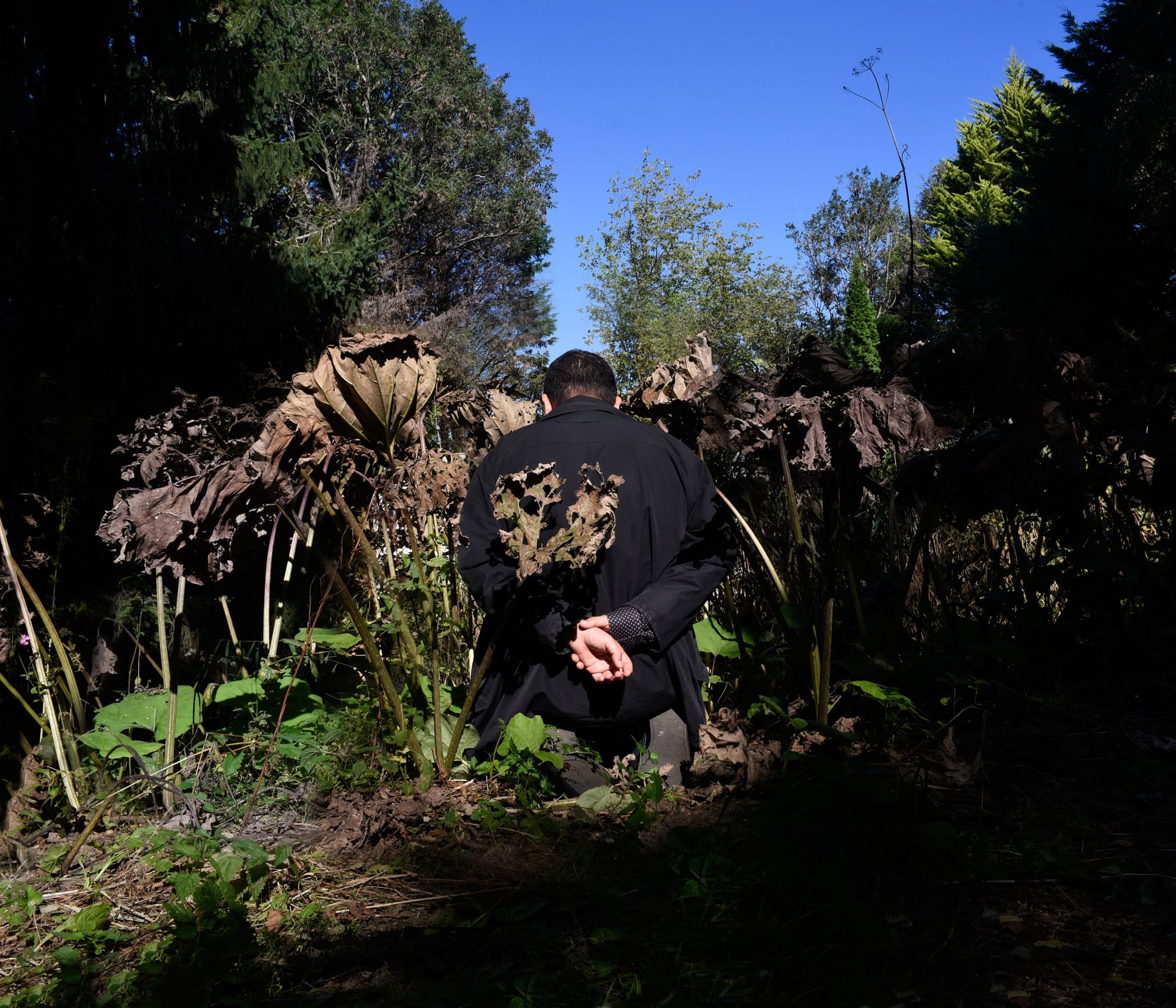
LOS ANGELES — When Iraqi artist Ali Eyal was nine years old, his mother led him and his siblings to an amusement park in Baghdad. As they boarded the Ferris wheel, she instructed them to observe the city’s landscape, encouraging them to memorize the view. It would be the last time Eyal witnessed his homeland in a state of peace. Shortly after, the United States initiated airstrikes across Iraq, marking the start of a nearly decade-long conflict that would irrevocably alter Eyal’s life.
"We were children, and I didn’t grasp the significance of her gesture," Eyal reflected during an interview with Hyperallergic, "but now it resonates. Sometimes understanding simple gestures takes years."
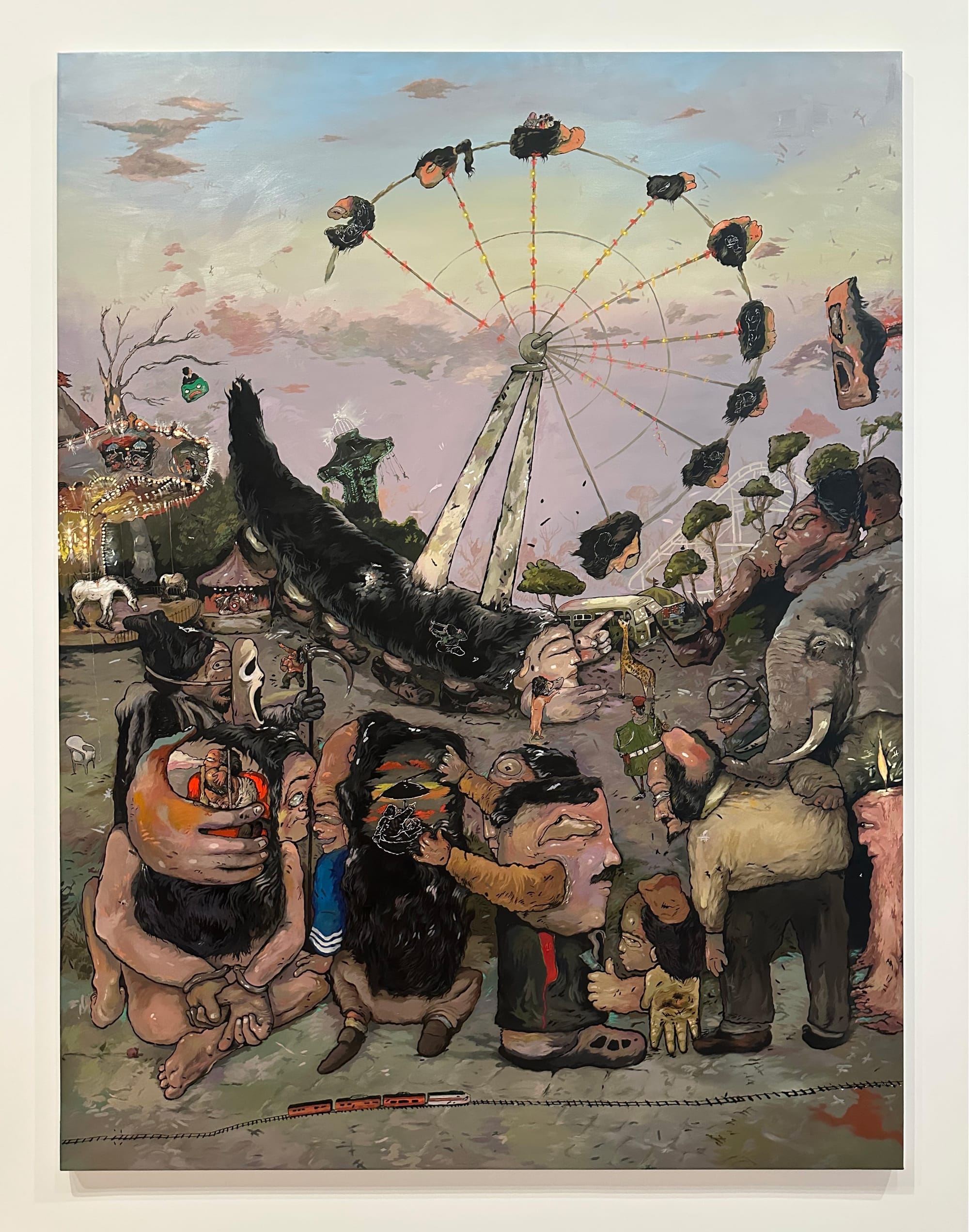
This recollection forms the foundation of Eyal’s latest oil painting, "Look Where I Took You" (2026), which debuts at the Whitney Biennial on Sunday. The piece evokes a surreal, dreamlike atmosphere, where innocence is distorted by ominous undertones. The Ferris wheel cars have been transformed into heads impaled by steel spokes, while an armed guard oversees a queue of grotesque visitors. To the left, a figure in a Ghostface mask wields a grim reaper’s scythe — a metaphor for American forces responsible for the deaths of hundreds of thousands of Iraqis, according to most estimates. In the foreground, a child version of Eyal observes the scene with a detached expression, unaware of the horror unfolding before him.
"Look Where I Took You" exemplifies Eyal’s artistic approach. He employs painting, drawing, installation, and video to convey narratives shaped by trauma, loss, and youthful innocence. Eyal departed Baghdad almost ten years ago, studying at the Institute of Fine Arts in Baghdad, then working in Lebanon and France, before relocating to Los Angeles in 2022 when his spouse, interdisciplinary artist Samar Al Summary, began attending the University of California, Los Angeles. Yet, he continues to grapple with the war’s lasting impact on his family.
A pivotal memory involves the disappearance of his father. Eyal described him as a man of modest means who worked for the local municipality, seemingly not a target. He recalls an Iraqi militia invading their home during the Arba'in pilgrimage, a major religious gathering. Initially, the family believed the militia was there to protect the pilgrims, but instead, they used the event as a cover to break into their house and abduct his father.
"They had a list of names," Eyal explained. He assisted his mother in searching for his father in forensic hospitals and American military bases, but they never found him.
"I was nine years old, and I felt like I lost my childhood," Eyal said.
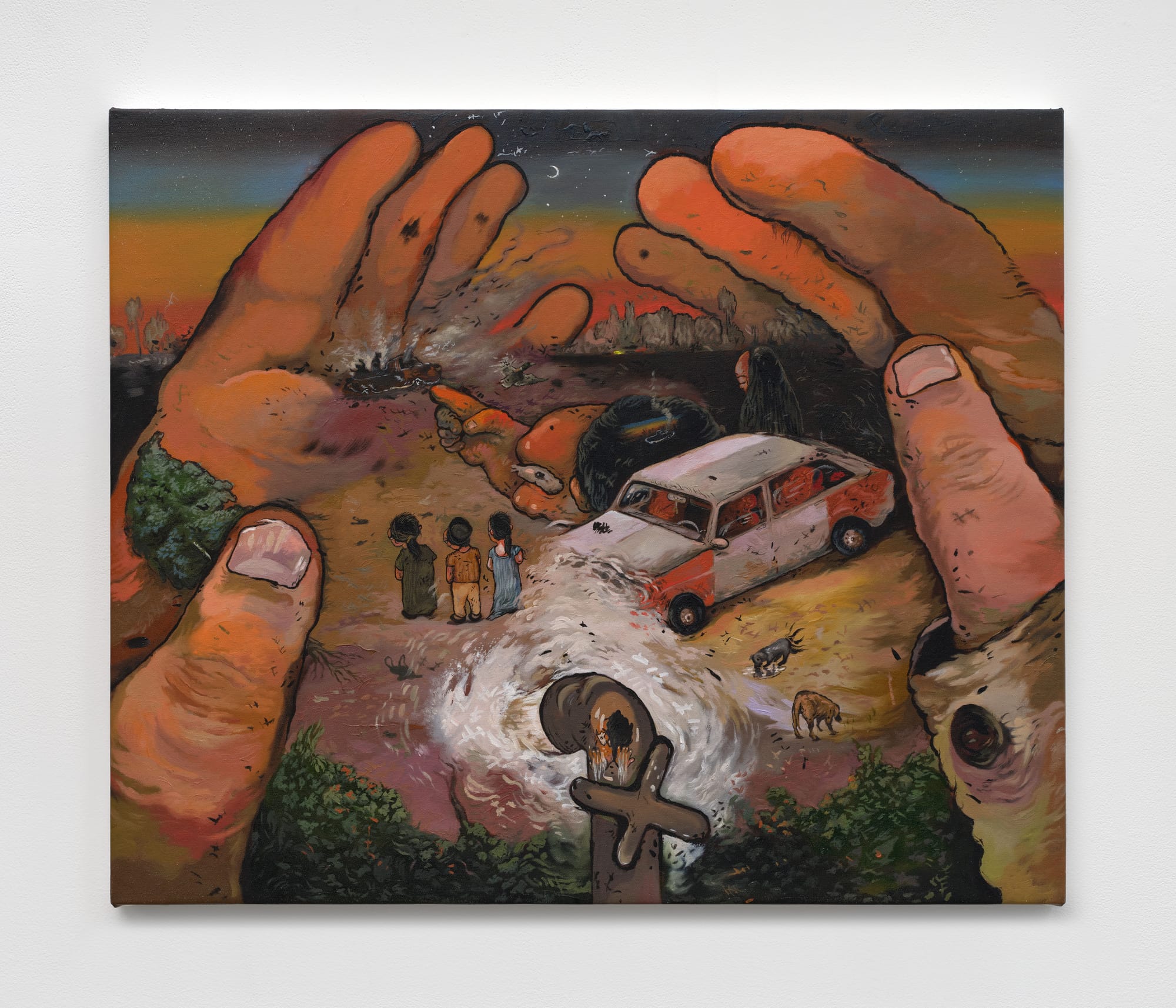
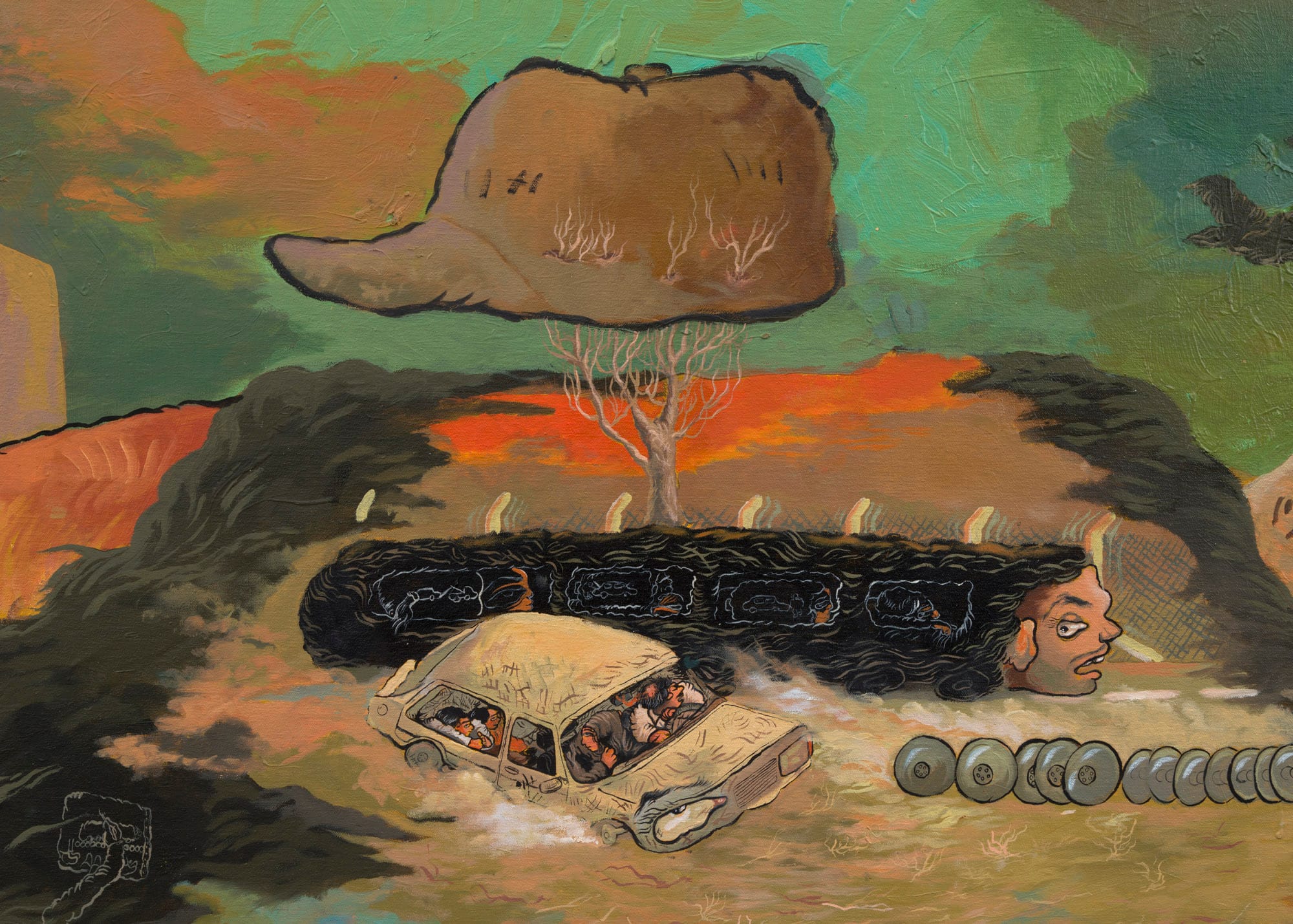
Eyal explores memories of his father and his disappearance in multiple works. "The road to an unknown hand" (2024) depicts his family squeezed into a sedan, swerving on a foggy road, with tire imprints trailing ahead, heading toward a crash. In "Please look where they took us" (2026), Eyal’s father appears as a cartoonish, oversized figure towering over the children, pointing toward the charred remains of a car in the distance, with two bodies still visible inside. Each of these works foreshadows the fate of Eyal’s father’s vehicle, which was bombed, with the perpetrators remaining unidentified.
Most of Eyal’s works are accompanied by text that recounts stories from his childhood. He may describe lying on the floor watching ants for hours or recount the time his father retrieved a stone from a destroyed shrine, hoping it would ward off evil. While the core memory remains true, he often fictionalizes the margins. "And Look Where I Went" (2025), his Mohn Award-winning piece from the most recent edition of Made in L.A., imagines a hot dog vendor in New York City, despondent due to having left his family in Egypt. His memories dominate the right side of the canvas, where a person weeps, body bags loom, and water pours into an abyss. On the left-hand side, Eyal inserts himself into the scene, reaching out toward the tormented vendor, as if offering comfort.
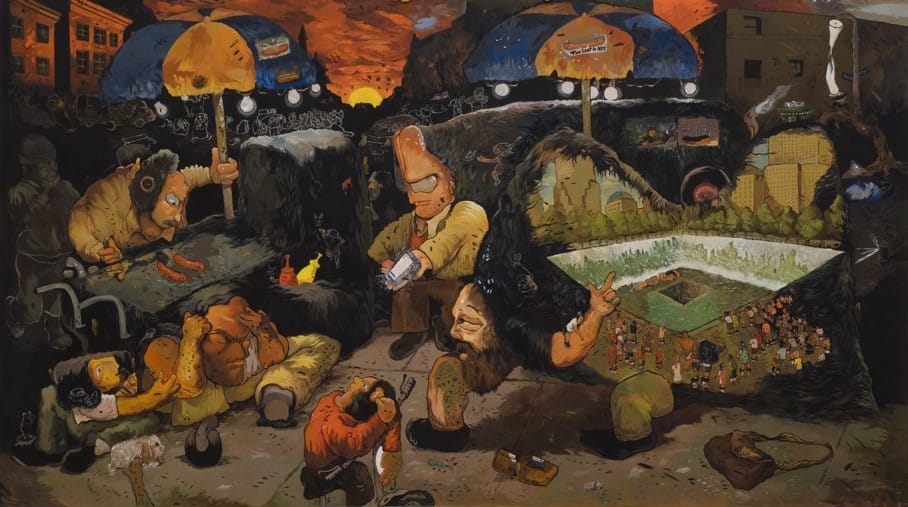
Eyal partially bends the truth due to PTSD, which has fragmented his memory, but also because it helps build empathy with his audience. His scenes offer viewers a new lens through which to understand the battleground — "fertilizing it with my own fiction with respect to the victims and people who survived," as he puts it. This is his way of bearing witness.
Eyal also strives to incorporate beauty into his work. These elements may stem from small, tender moments. "Could you please paint this?" (2025), for instance, includes a hand holding out a moldy orange. It belongs to his mother, who saw enchantment in the rotting fruit; she wanted her son to capture the orange and green hues of the peel.
However, heaviness is an inescapable element of his art. Often, Eyal’s scenes are illuminated by stunning sunsets that bathe them in orange and yellow. These colors, and what they represent, carry a dark history. The U.S. typically launched its heaviest attacks at sundown, and dusk still causes Eyal anxiety. He is currently working on a monograph exploring sunsets as a way to cope with his fear.
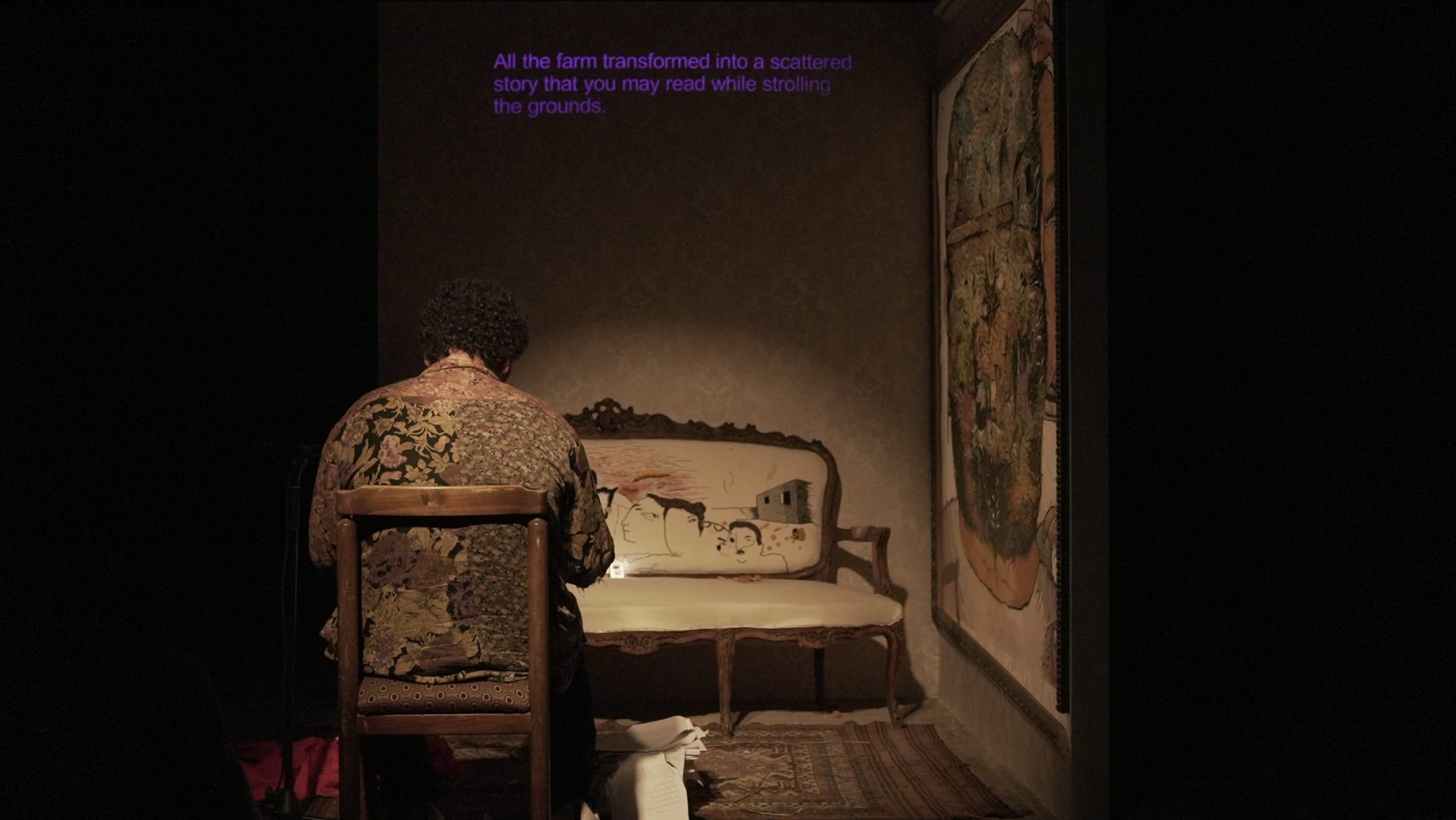
While Eyal has used his artwork as a means of healing, the trauma of the past lingers. Two days before his interview, the U.S. and Israel bombed Iran. In response, Iran targeted military bases throughout the Gulf region, including in Baghdad, where Eyal’s mother felt the tremors. Analysts drew parallels between this aggression and the war of his childhood.
"I feel paralyzed. I felt like I became a kid when I looked at a TV this morning," Eyal said. "The only thing that I wish for my mom, and my family, is to have rest from wars."
Editor’s Note, 3/10/2026, 4:40pm EDT: An earlier version of this article referred to Ali Eyal's siblings as "young boys" in "Please look where they took us" (2006). We have updated this to reflect that his sisters are also depicted.