
Olympic figure skating champion attended the AW26 runway show, offering a front-row perspective on a collection that evokes a journey into the wild. The presentation blended technical precision with natural inspiration, reflecting a growing trend in fashion to merge sport and environment. Industry observers note this alignment underscores the evolving intersection of athleticism and avant-garde design.
March 10, 2026

“I was nine years old, and I felt like I lost that childhood,” said the Whitney Biennial artist in an interview with Hyperallergic, reflecting on the lasting impact of the U.S. war in Iraq, the disappearance of his father, and the deeply personal work he creates. His art serves as both a historical record and emotional archive, offering a poignant lens through which to examine the intersection of trauma, identity, and political conflict in contemporary art. The piece underscores how personal loss shapes artistic expression, resonating with broader conversations around memory, displacement, and cultural narrative in the tech-driven creative landscape.
March 09, 2026

His latest exhibition, "I Bring Home With Me," merges portraiture with immersive seating arrangements and a detailed studio model, creating an interactive space that encourages prolonged engagement and emotional connection. The concept reflects evolving trends in experiential art, emphasizing audience participation and spatial storytelling—key considerations for contemporary design and tech-driven exhibition strategies.
March 09, 2026

The Pittsburgh artist gained minimal recognition until the final decade of his career, when his work began to receive broader attention and critical acclaim. Industry experts note that this delayed appreciation reflects broader trends in art market dynamics, where regional talent often remains undervalued until late in an artist's career. This case underscores the importance of sustained institutional support and curatorial efforts in elevating underrepresented voices in the tech and creative sectors.
March 09, 2026

Lisette Model and pioneering photographers redefined visual storytelling, shaping how we document and interpret social movements through the lens of history. Their work laid the foundation for modern photojournalism, emphasizing authenticity, human emotion, and societal change. In today’s tech-driven world, their legacy underscores the power of imagery in shaping public perception and driving digital activism. As AI and data analytics increasingly influence media, the principles established by these early photographers remain vital in ensuring ethical, impactful visual narratives.
March 09, 2026

Kingsbury, a community with fewer than 700 residents, has emerged as a focal point for cultural governance and indigenous sovereignty, driven by the strategic efforts of the arts organization Habitable Spaces. This grassroots initiative highlights the growing intersection of art, policy, and community empowerment in rural tech and social innovation ecosystems.
March 09, 2026

Joumana Asseily temporarily shuttered her Beirut gallery as evacuation orders were issued last week, reflecting the growing instability in the region. The move underscores the challenges facing cultural institutions in conflict-affected areas, highlighting the need for resilient strategies in arts management. As tensions escalate, the art world remains on high alert, with stakeholders closely monitoring developments that could impact operations and collections.
March 09, 2026

"If paint doesn't flow smoothly from the brush, the artist's vision falters," notes a painter whose work captures the chaotic beauty and inherent contradictions of the human experience. In the tech industry, this sentiment mirrors the importance of seamless user experiences—where even minor friction can derail engagement and innovation. Just as an artist relies on material performance, tech professionals must prioritize intuitive design and reliable functionality to drive adoption and satisfaction.
March 10, 2026
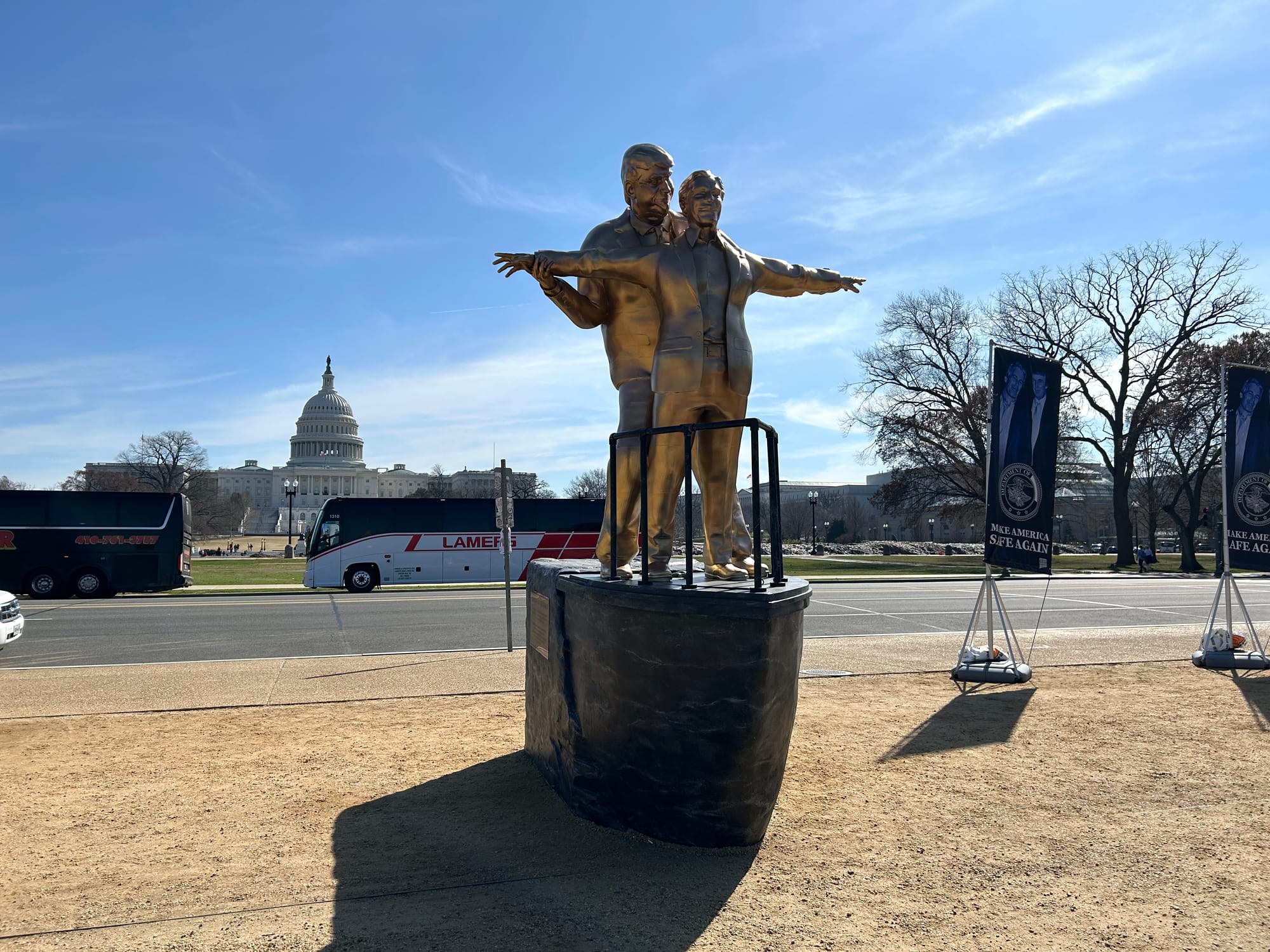
The newly unveiled sculpture on the National Mall coincides with the release of previously classified documents outlining allegations of misconduct against Trump, sparking renewed public and media scrutiny. The artwork, positioned at a symbolic location, underscores the ongoing dialogue around accountability and historical memory in the digital age. Industry experts note that such cultural expressions reflect broader trends in how society processes political narratives through visual and public art, emphasizing the intersection of technology, media, and civic engagement.
March 10, 2026

Qatar's criminalization of LGBTQ+ identities — punishable by imprisonment and deportation — stands in direct contradiction to its carefully cultivated global brand as a progressive cultural and creative destination. As someone who fled the country to live authentically as a queer person, I can attest that no amount of world-class infrastructure, international festivals, or soft-power investment can reconcile that fundamental hypocrisy.
The Gulf state has aggressively positioned itself as a hub for innovation, arts, and global dialogue — hosting everything from the FIFA World Cup to high-profile media and technology summits. Yet beneath this veneer of cosmopolitan ambition lies a legal framework that criminalizes the very diversity these platforms claim to celebrate. For LGBTQ+ professionals, creatives, and technologists, participation comes at an existential cost invisible to those who don't bear it.
The tech and creative industries, which pride themselves on inclusion and psychological safety as drivers of innovation, must interrogate the ethics of legitimizing such environments through partnerships, conferences, and investment. Platforming Qatar as a beacon of creative freedom isn't neutral — it actively obscures the lived reality of those forced to choose between identity and safety.
Authentic creative ecosystems cannot be built on selective freedom. Until meaningful legal protections exist for LGBTQ+ individuals, the international community should resist narratives that conflate economic modernization with genuine human rights progress.
March 10, 2026

**Russia's Biennale Participation Sparks Cultural Reckoning Amid EU Funding Threats**
High-profile cultural activists, including Pussy Riot co-founder Nadya Tolokonnikova, have added their voices to a growing petition challenging Russia's continued inclusion in the prestigious Biennale arts festival — a move that carries significant geopolitical weight as the European Union signals it may withdraw financial support over the controversy. The standoff highlights the increasingly blurred boundary between cultural diplomacy and political accountability in internationally funded arts institutions, forcing curators, sponsors, and policymakers to confront whether prestigious creative platforms can remain neutral in the face of geopolitical conflict.
March 10, 2026

Iran's Cultural Heritage Under Threat: Historic Safavid Landmarks Caught in Regional Conflict
The 17th-century Chehel Sotoun palace in Isfahan — a UNESCO World Heritage Site celebrated for its extraordinary Safavid-era frescoes and 40-columned reflective pavilion — is among multiple irreplaceable Iranian landmarks now facing damage risk amid escalating regional hostilities. The Persian imperial complex, whose intricate painted murals document court life, diplomatic ceremonies, and military campaigns of the Safavid dynasty, represents a category of cultural asset that, once compromised, cannot be algorithmically restored or digitally replicated to its original integrity.
For the heritage preservation and cultural technology sectors, this development underscores a critical gap: despite advances in photogrammetric documentation, LiDAR scanning, and AI-driven restoration modeling, the digital twin infrastructure for many Middle Eastern UNESCO sites remains incomplete or inaccessible in crisis scenarios. Organizations such as CyArk and the Aga Khan Trust for Culture have pioneered rapid-response heritage digitization, yet geopolitical instability consistently outpaces archival readiness.
The targeting — or collateral exposure — of recognized cultural monuments also carries significant legal dimensions under the 1954 Hague Convention and its protocols, raising accountability questions that increasingly intersect with open-source intelligence (OSINT) verification methodologies now standard in conflict documentation.
Beyond geopolitics, the potential loss of Chehel Sotoun's frescoes represents an irreversible compression of human historical data — the kind of information loss that no retrieval system, however sophisticated, can reverse.
March 10, 2026

**"Flat Earth" and the Limits of Insular Literary Ecosystems**
Anika Jade Levy's debut novel *Flat Earth* exemplifies a growing tension in contemporary fiction: work engineered for its own subculture rather than built to travel beyond it. Self-referential to the point of recursion, the novel functions less as literature and more as a closed-loop signal — broadcasting exclusively to the Dimes Square demographic it documents, with diminishing returns for anyone outside that narrow bandwidth.
In an era where niche content can theoretically find its audience at scale, *Flat Earth* raises a sharper question: when does hyper-targeted storytelling collapse into solipsism? Levy's prose mirrors the very insularity it portrays, creating an ouroboric structure that mistakes self-absorption for depth. The result is a work that validates its in-group with precision while offering little architectural value to the broader literary stack.
For readers tracking the intersection of downtown Manhattan aesthetics and post-ironic cultural production, *Flat Earth* is a data point worth noting — but its signal strength drops sharply at the perimeter of its own scene.
March 10, 2026

# The Quantum Advantage: How Entanglement Could Revolutionize Deep-Space Communication
Signal attenuation remains one of the most persistent engineering challenges in terrestrial and interplanetary communications infrastructure. Conventional electromagnetic transmissions — whether acoustic, optical, or gravitational wave-based — suffer from the **inverse-square law**, dispersing energy across three-dimensional space and degrading signal integrity with every kilometer traveled.
This fundamental physics constraint has long defined the ceiling for long-range data transmission fidelity. But emerging research into **quantum entanglement** suggests we may be approaching an architectural inflection point.
Unlike classical signal propagation, quantum-entangled particles maintain instantaneous correlated states regardless of physical separation — a phenomenon Einstein famously dismissed as "spooky action at a distance." For deep-space communication networks and next-generation satellite infrastructure, this represents a potentially transformative departure from legacy RF and laser-based protocols.
The engineering implications are significant: **quantum communication channels theoretically immune to distance-based degradation** could redefine latency and bandwidth parameters for missions beyond low-Earth orbit, where current signal round-trip times to Mars already exceed 20 minutes.
From an enterprise technology perspective, this research trajectory intersects directly with investments in **quantum networking, space-based internet infrastructure**, and secure communications — sectors attracting substantial venture capital and government R&D expenditure.
The transition from theoretical physics to deployable communication technology remains complex, but the signal is clear: quantum mechanics may ultimately render the inverse-square law a legacy constraint rather than an immovable ceiling.
March 06, 2026

# From Data to Decisions: Why Action Separates Tech Leaders from Tech Talkers
H. Ross Perot—the visionary entrepreneur who built Electronic Data Systems (EDS) into a multinational IT powerhouse before twice challenging for the U.S. presidency—distilled leadership to its irreducible core: *"Talk is cheap. Words are plentiful. Deeds are precious."*
In an industry drowning in buzzwords, roadmaps, and quarterly narratives, Perot's philosophy cuts with surgical precision. The technology sector has never suffered a shortage of vision statements or innovation manifestos—yet the organizations that consistently deliver transformative outcomes share one distinguishing trait: an unrelenting bias toward execution.
For today's tech professionals and enterprise leaders, this principle carries renewed urgency. Agile sprints, DevOps pipelines, and AI-driven automation have compressed delivery cycles dramatically, raising the stakes for accountability at every level. The gap between articulating a digital transformation strategy and actually shipping value to end users remains the defining competitive differentiator.
Perot's legacy—building EDS from a single contract into a billion-dollar IT services giant—wasn't constructed on compelling pitches. It was engineered through disciplined delivery, measurable outcomes, and a culture where results outranked rhetoric.
The lesson for modern technology organizations is both timeless and tactically relevant: **architect fewer promises, deploy more solutions, and let your commit history speak louder than your keynote.**
March 06, 2026
